
State of the software engineering job market in 2026
A deepdive into today’s tech jobs market, with exclusive data on software engineering jobs, the AI engineering boom, whether AI engineering is “replacing” software engineering hiring, and more


Last year, I described the tech jobs market as “weird”, based on reports from both job seekers and hiring managers. In this deepdive, we dig into what – if anything – has changed in 2026.
A year ago, most engineers found it harder to get responses to job applications, while hiring managers found it harder to hire than before. We’ve now spent two months gathering fresh, never-before-shared data from a range of sources to find out if that paradoxical situation still exists or not.
We collected the data with software engineer Jessica Salmon – who’s joined the team as a tech industry analyst. A big thank you to partner teams who shared exclusive details for this deepdive:
TrueUp: a platform that scans every open job in Big Tech, top startups, and scaleups, typically paying in the top two tiers of the trimodal software engineering compensation model. Thanks, Amit Taylor.
Workforce.ai, built by Live Data Technologies, which monitors 1M+ job changes and 300M+ employment validations each month across companies, roles, levels, functions, industries, and locations. Special thanks to Alex Hamilton for his input.
Today, we cover:
Software engineering recruitment: trending up, mostly. More software engineering job postings in the UK and the US, and a decline in Germany and France. “Top” tech companies are hiring 20% more vs a year ago.
Big Tech and publicly-traded companies. Meta went on a monster hiring spree for the last two years until layoffs, last week. Microsoft and Amazon were flat, while Google and Apple consistently hired devs. Stripe, Shopify, and Atlassian all hired more than Big Tech.
Who’s hiring the most software engineers? Apple, Amazon, and IBM are the top 3 by number of positions listed, while Meta dropped off the top 20 with layoffs there. The fastest-growing companies seem to be in fintech, observability, and security.
AI engineering: explosive demand. Most tech companies seem to be prioritizing AI engineering recruitment over software engineers. Observability companies appear to be hiring fastest.
Who’s hiring the most AI engineers? Apple, Google, and TikTok have the most openings, and many larger tech companies have 50-100% more AI engineering job listings than a year ago.
Is AI engineering replacing software engineering hiring? The data doesn’t say, but are the basics of AI engineering becoming a baseline skill for software engineering job candidates?
See Part 2 for details on:
Top AI labs are now more attractive than Big Tech
Harder for new grads & interns to get hired
Mobile and frontend demand drops, AI & FDE surges
AI engineering comp > software engineering comp
Management’s “great flattening” continues
Big Tech seniority & tenure keep rising
Interview preparation signups: what do they indicate?
Where engineers go after Big Tech
See Part 3 for stories from hiring managers and job seekers, covering:
“Catch-22:” nobody finds each other
No trust. Is AI to blame?
Hot market for some, but tough for most
Higher hiring bar & lower compensation – but not for everyone
Engineering leader recruitment: also weird for senior ICs
US market trends
Trends in the UK, EU, and rest of the world
For more on the tech jobs market of 2025, check out last year’s deepdive.
1. Software engineering recruitment: trending up, mostly
Top tech companies hiring more, slowly but surely
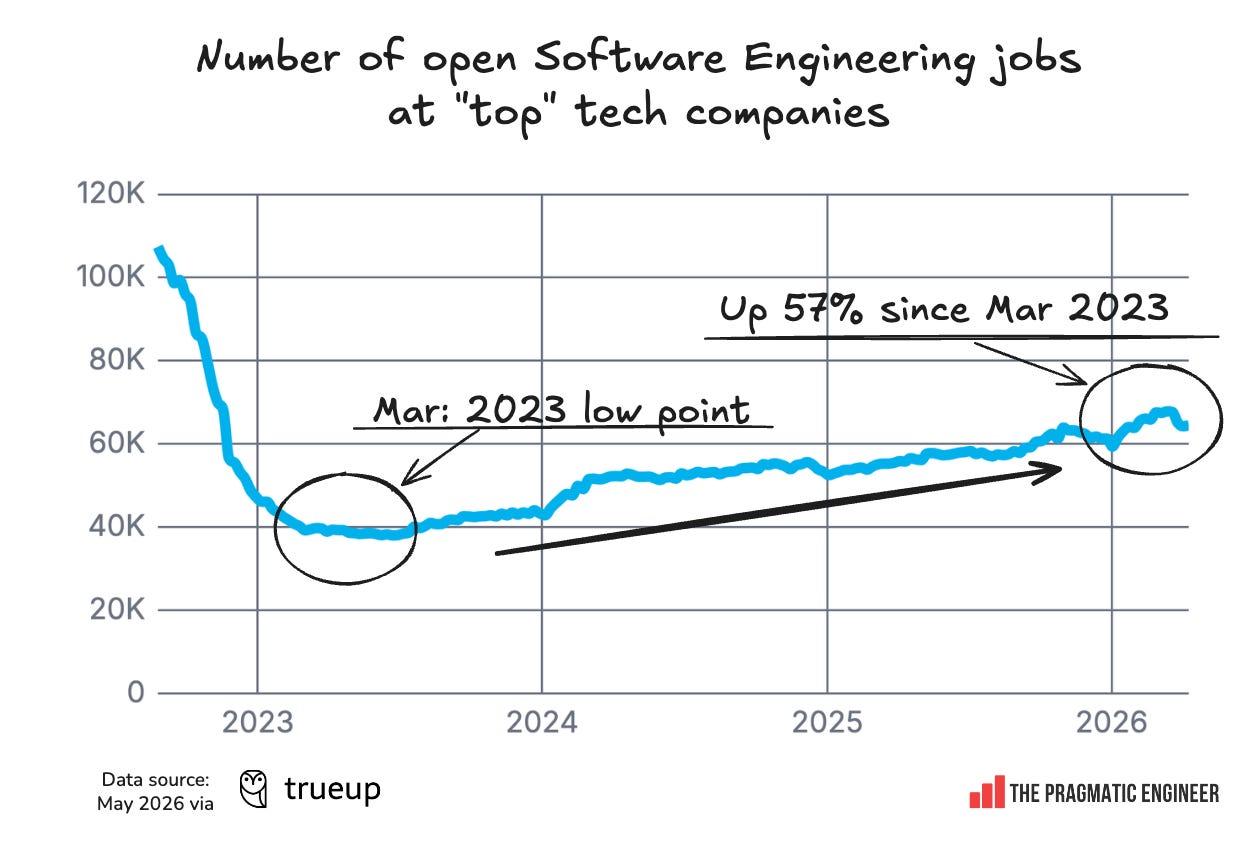
TrueUp tracks open positions at top-paying companies, which are usually US-based. Among this group, recruitment of software engineers has been steadily increasing since March 2023:
US growth, but less in Canada and Europe
Let’s take a look at broader industry trends via software developer jobs listed on Indeed.com, the world’s largest job aggregator site. As a “jobs aggregator”, Indeed not only displays paid-for ads but also crawls many other career sites and lists the vacancies.
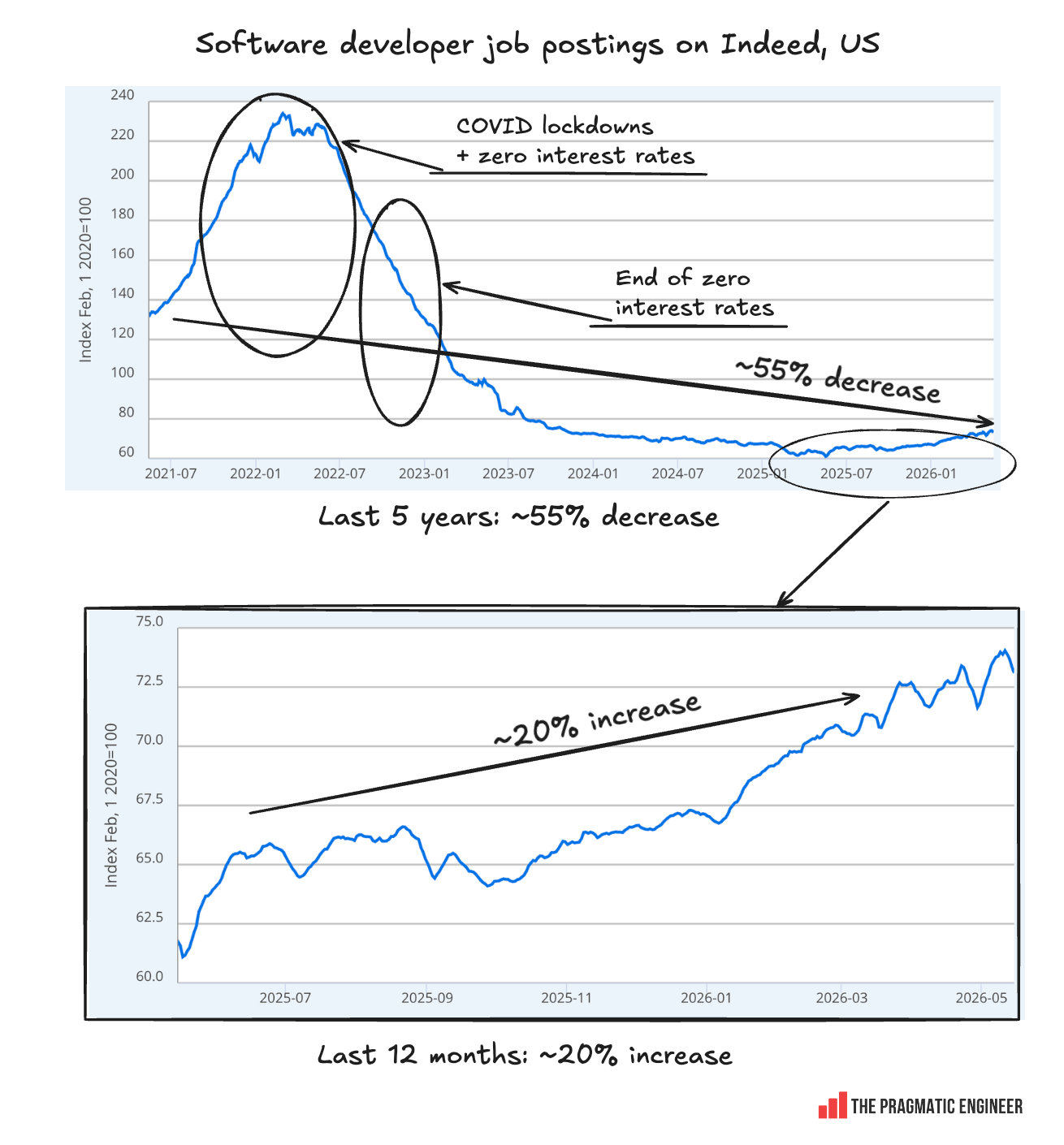
Looking at trends over the last five years, the number of software engineering jobs listed is still lower than in May 2021:
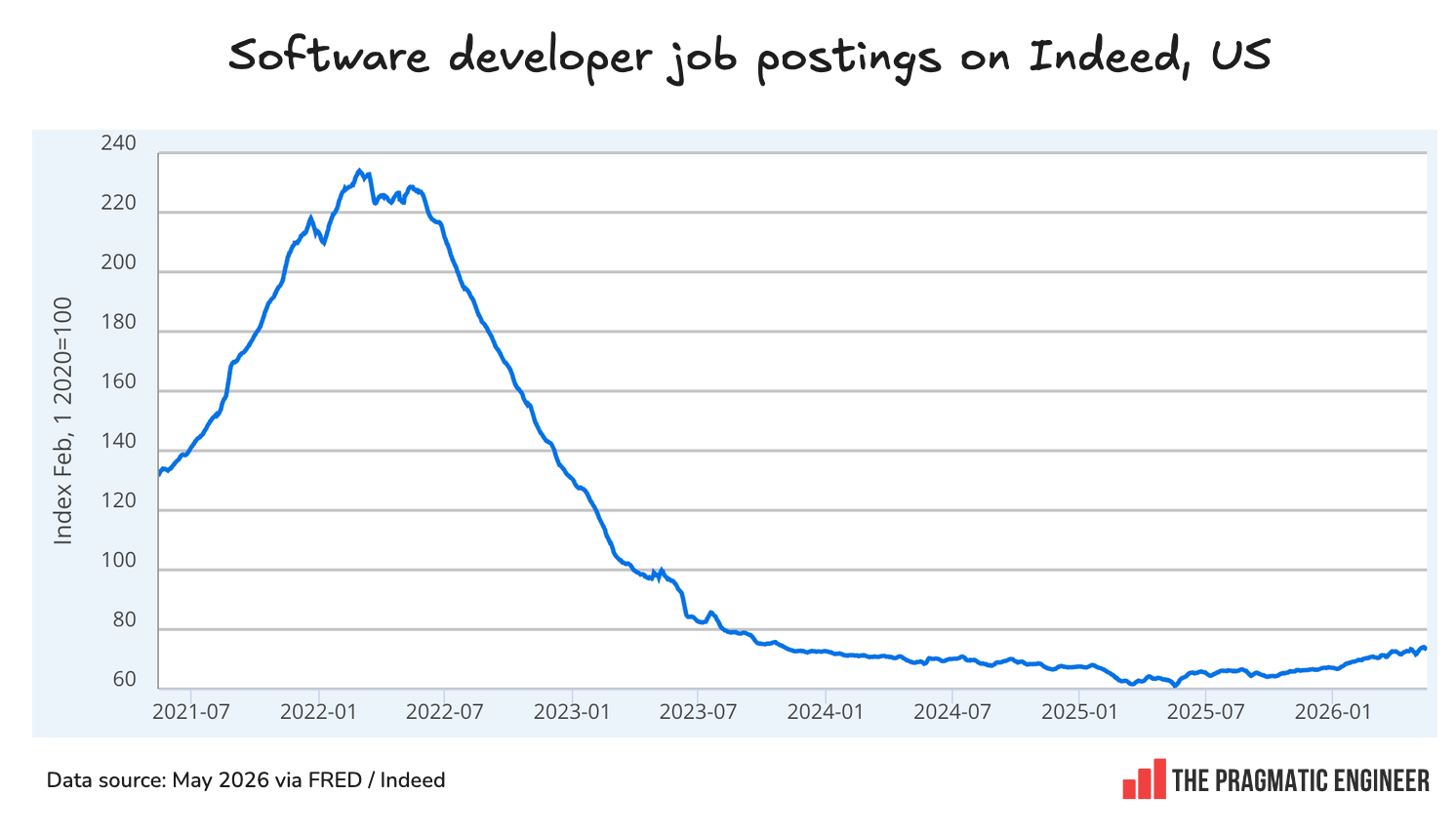
Obviously, 2021 was the pandemic which created a commercial boom for the tech industry, so it’s not exactly an ideal comparison. Zooming into the last twelve months shows encouraging growth signs:
Outside of the US, let’s check out software engineering vacancy trends, per Indeed:
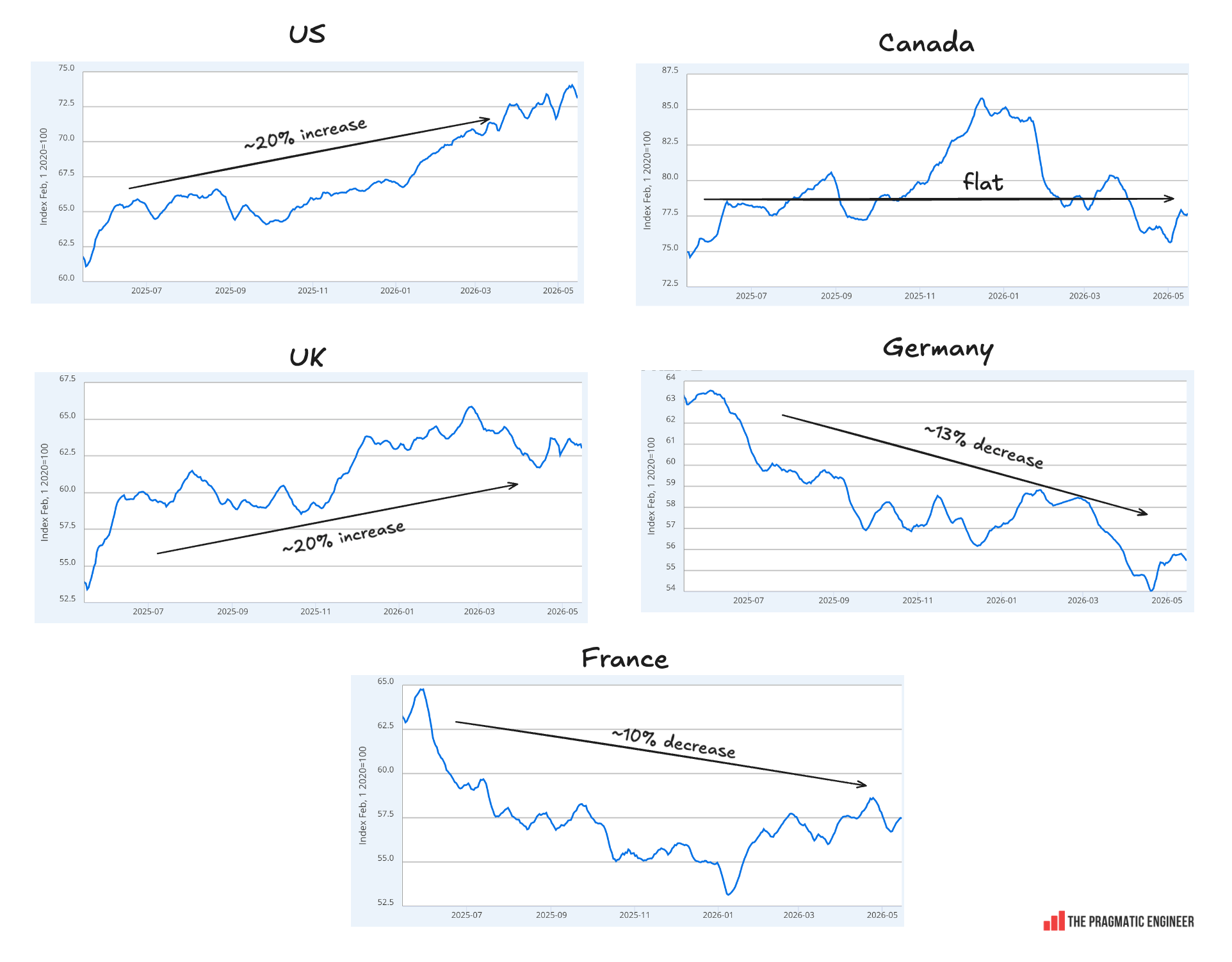
In this list, the US and the UK are the only two countries where vacancies are up; Canada is flat, while Germany and France have seen declines. To me, it suggests US-headquartered companies are hiring more devs, mostly in the US and some in the UK, whereas European-headquartered companies are more cautious about recruitment.
The software engineering industry still grows
Let’s ask how much the software engineer population has grown or shrunk in the last seven years. Here are some numbers from profiles, as tracked by Workforce.ai:
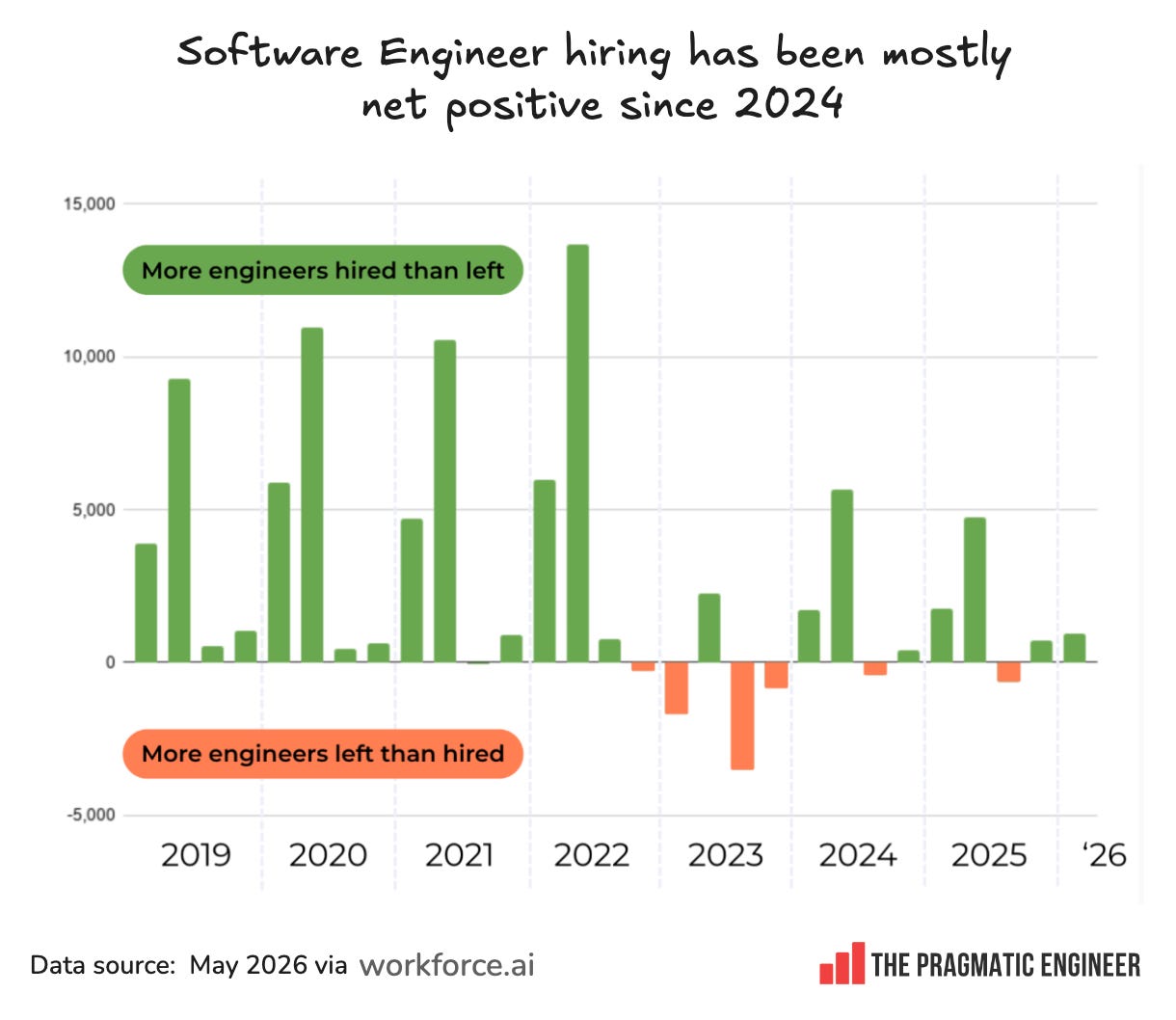
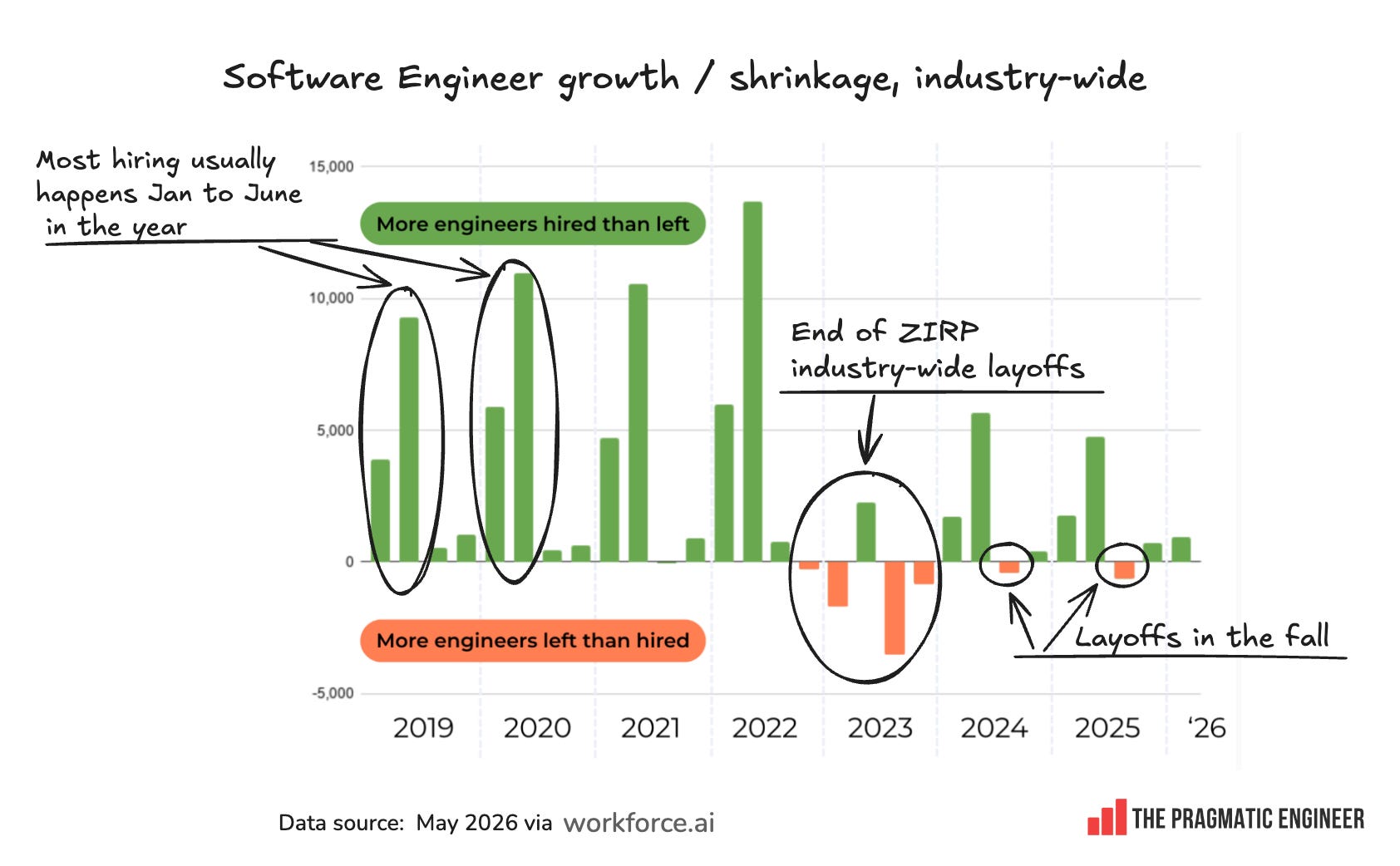
There are a few interesting details:
Hiring mostly occurs between the months of March and June, and there’s very little net growth in the second half of the year. This makes sense as tech companies set annual headcount budgets at the beginning of the year and commence hiring from then, with most hires evidently made in the following months. Hiring budgets are usually spent by mid-year.
The industry seemingly shrank in 2023. That year, it was only in Q2 that more software engineers were hired than left their jobs. It was the worst period for software engineers in two decades.
…and also in 2024 and 2025 during Q3. Mass layoffs mostly happened between August and October, the charts show.
2. Big Tech and publicly-traded companies
Big Tech: modest jobs growth – but not at Meta
Looking at the two years since May 2024, of the five largest tech companies, only Meta grew headcount aggressively:
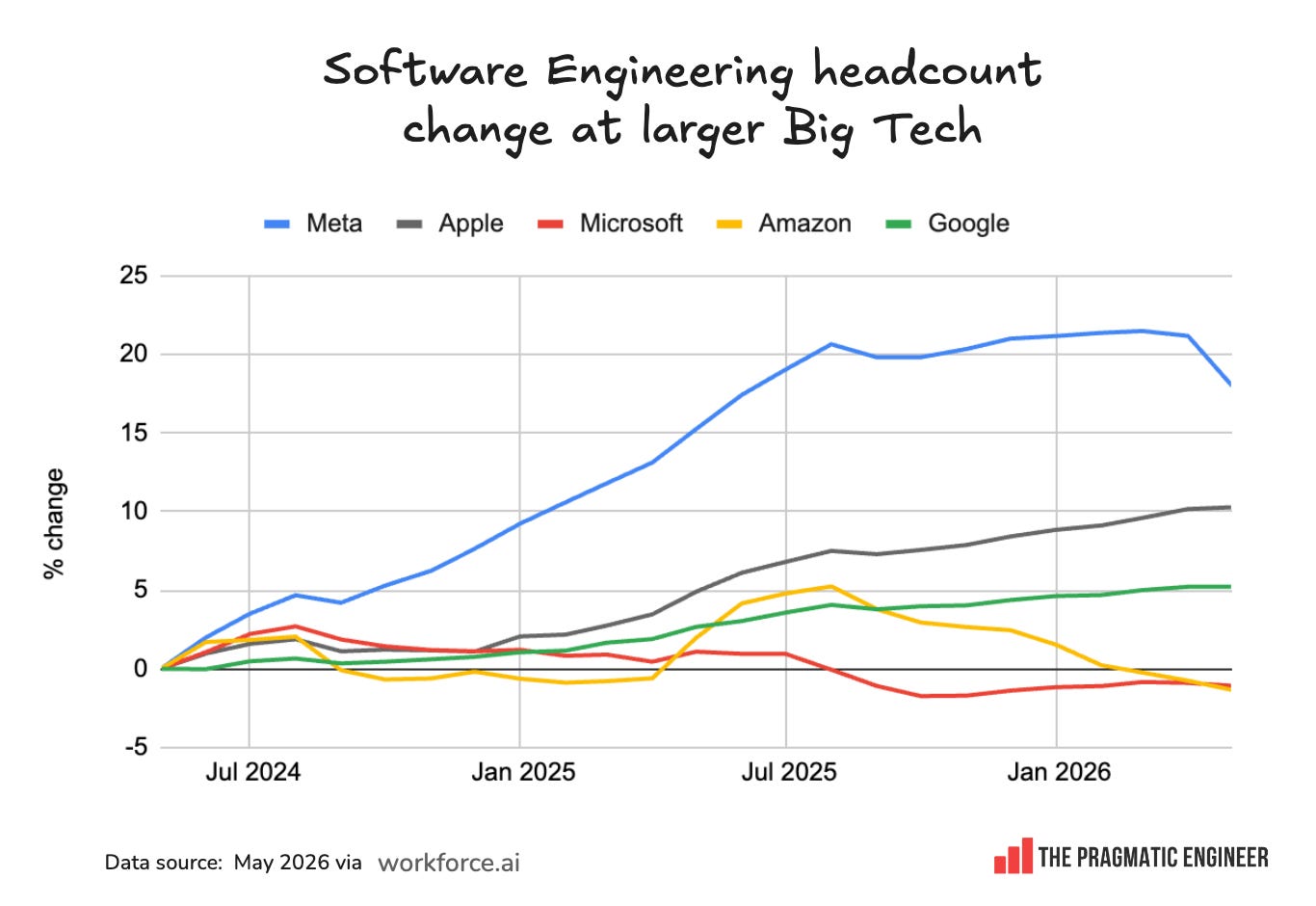
In that time, Meta increased its headcount by nearly 20%, so perhaps its recent 10% layoffs could be considered as not a total surprise. As for other tech giants, their software engineering headcount also changed in the last two years:
Apple: +10%
Google: +5%
Microsoft: -1.1%
Amazon: -1.3%
Visualizing this:
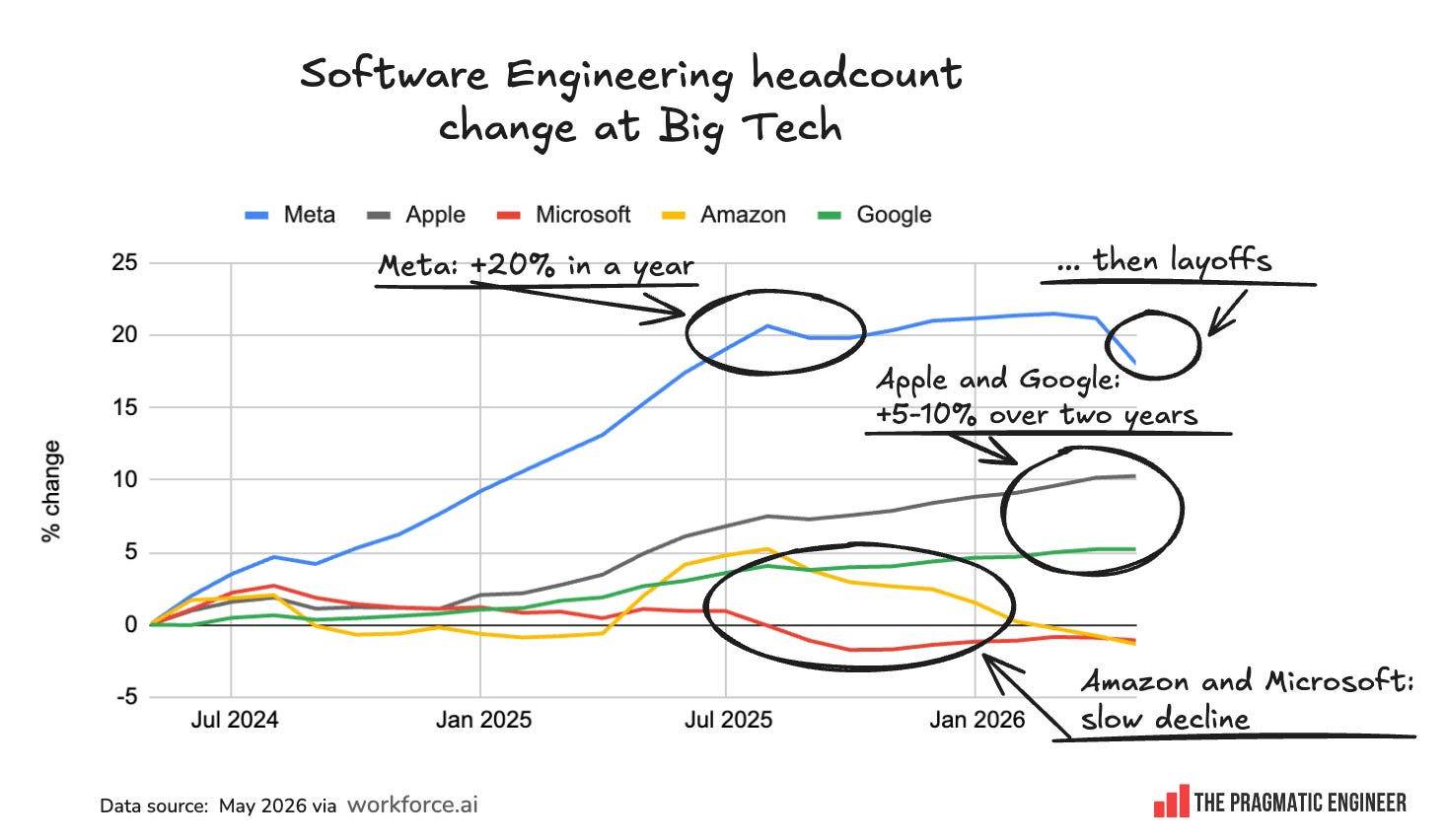
Apple and Google seem the most “stable” places when it comes to growing the software engineering function; Apple has not had mass layoffs for decades. In contrast, Meta is the most volatile place to work; hiring devs quickly and then letting them go. Elsewhere, Amazon and Microsoft are slowly employing more software folks.
Meta’s hire-then-fire rollercoaster
Meta warrants a closer look, where morale is reportedly as low as it’s ever been right now, due to layoffs of 10% of staff, while thousands of software engineers have been reassigned to manual data labeling from previous product development or infra work. From 2004 until 2022, Meta never did mass layoffs, but in the past three years there have been three sizeable redundancy rounds (at the end of 2022, early 2024, and last week), with the most rapid hiring growth of any tech giant sandwiched in between:
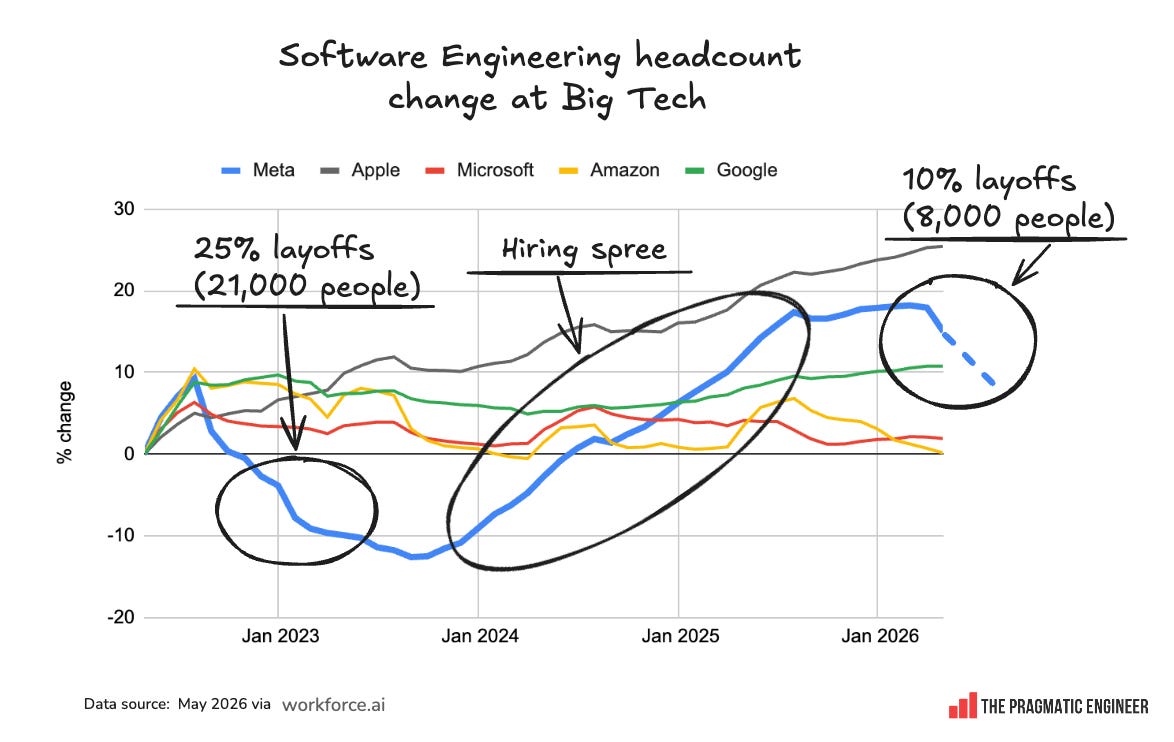
Before 2022, Meta ranked with Google as one of the most stable places to work in tech. Safe to say, the company is currently the riskiest place to be in job-security terms – even if Mark Zuckerberg has said there will be no more mass layoffs this year.
Publicly-traded tech companies: mostly flat recruitment
A couple of years ago, larger tech companies were hiring even more than most of Big Tech. Software engineering headcount grew in the past two years at Shopify (+36%), Stripe (+29%), Atlassian (+23%), Snap (+15%) and Spotify (+6%).
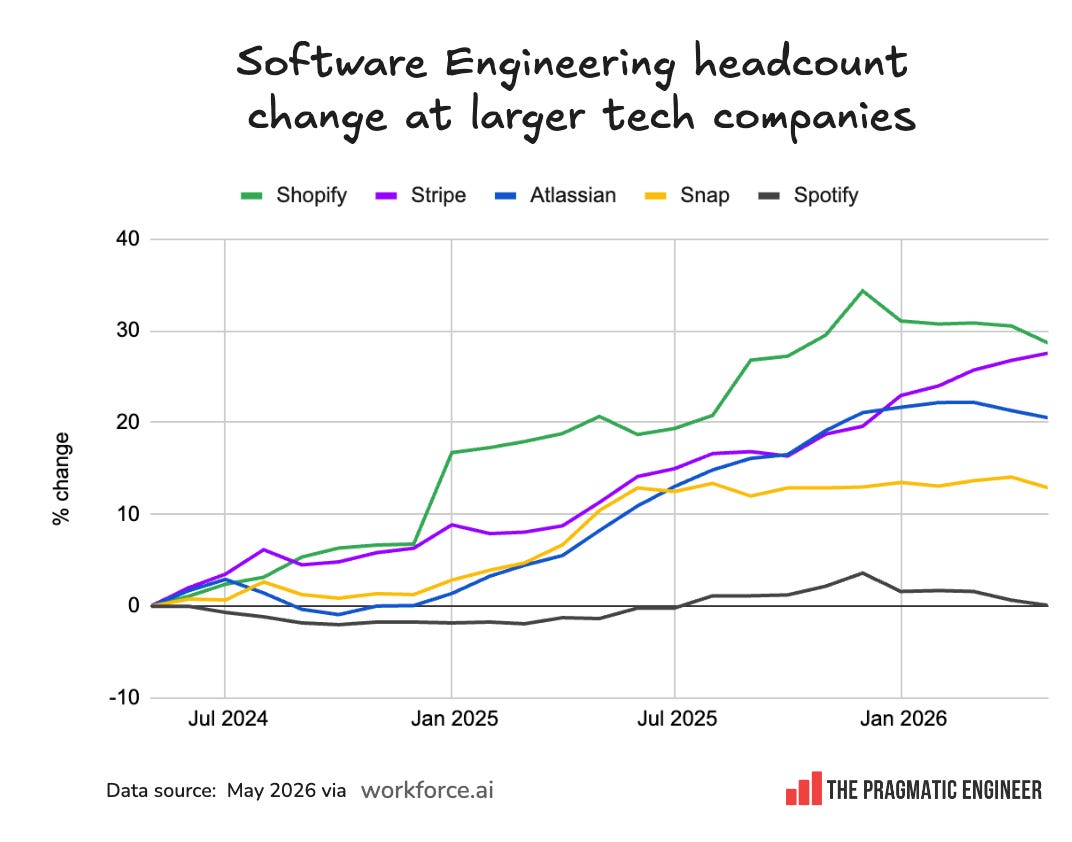
But that’s changed recently. In the past year, headcount growth has slowed at Stripe (+15%), Atlassian (+11%), Shopify (+6%), Snap (+2%), and Spotify (+1%),
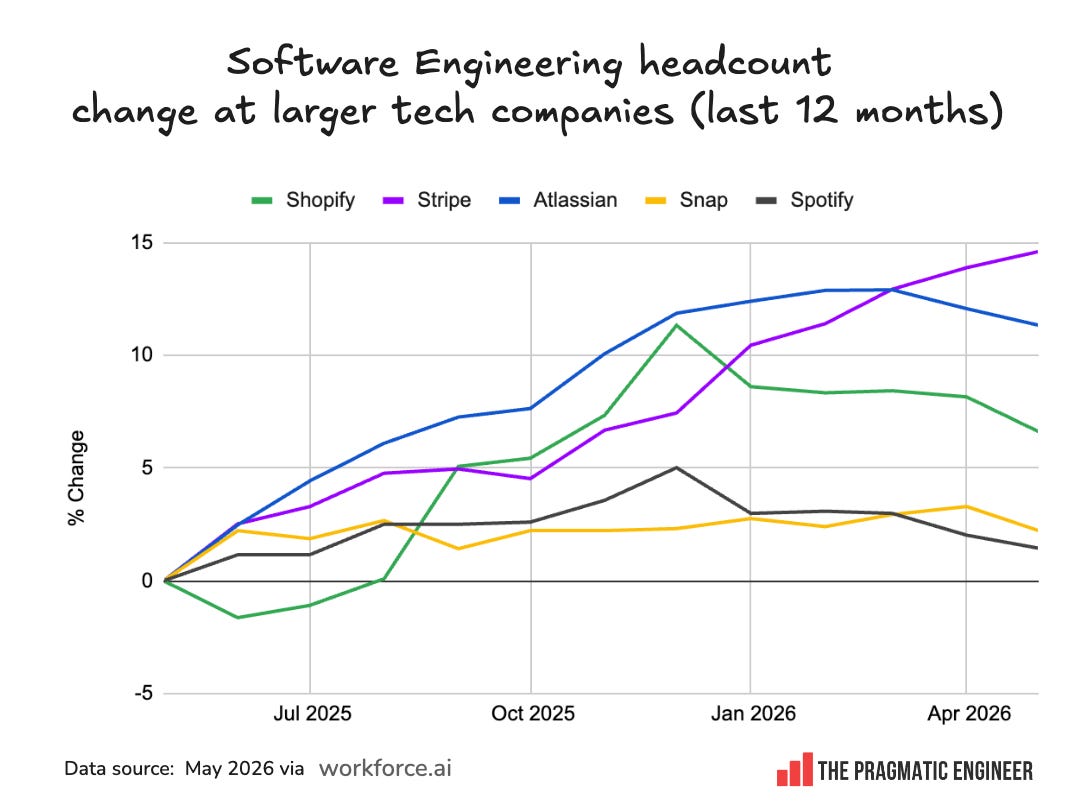
This data does not capture Atlassian letting go of 10% of staff this month, and Snap laying off 16% in April.
Among this group, Stripe stands out as a place that keeps hiring at a higher pace than nearly all of Big Tech. Atlassian and Shopify have grown their software engineering headcount faster than Google, Microsoft, and Amazon did in the past two years.
3. Who’s hiring the most software engineers?
So, which companies are hiring the most? Let’s look at this via open positions and growth comparisons.
Companies with the most open roles
“Top” tech companies with the largest number of software engineering openings:
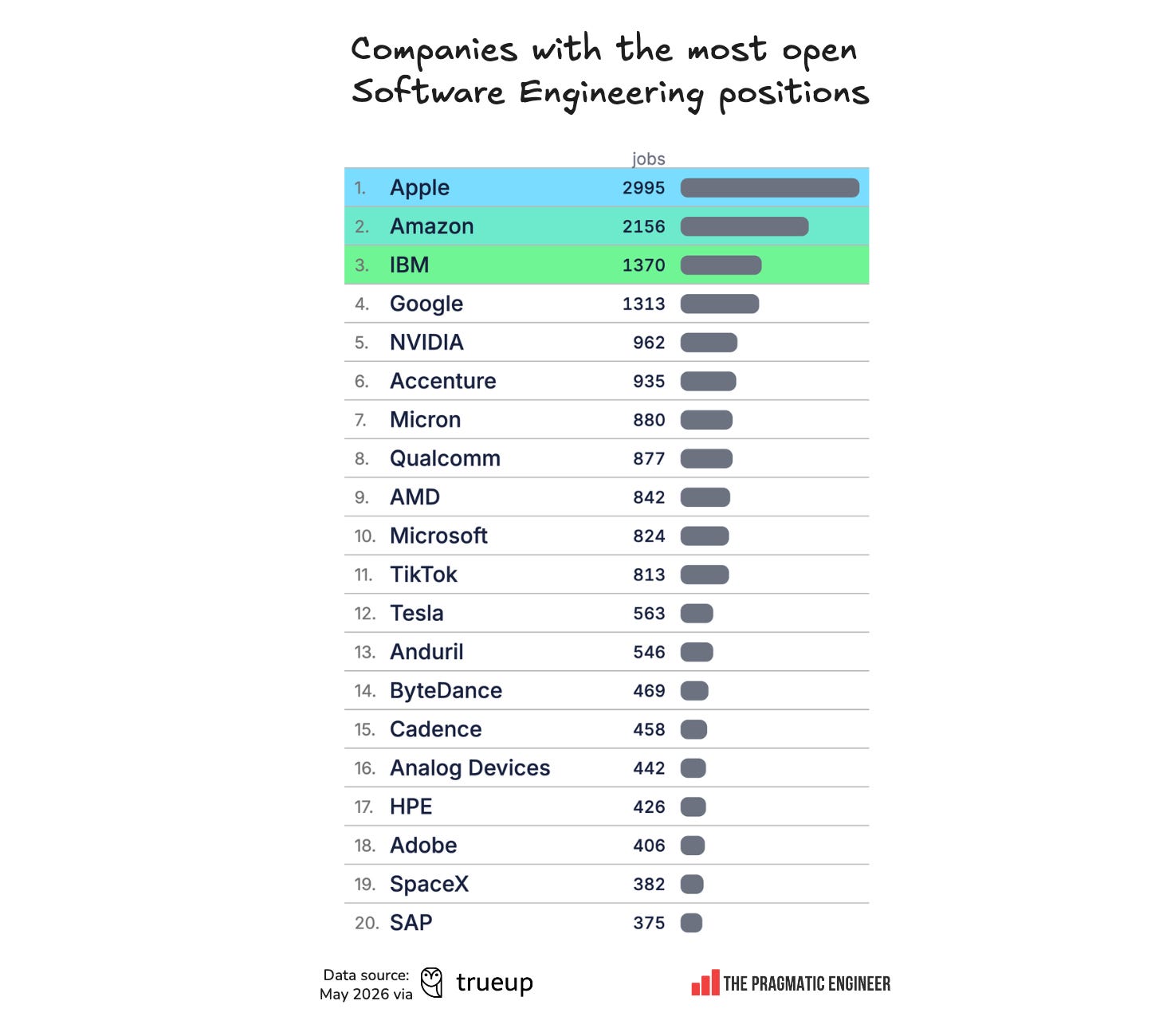
Compared to last year:
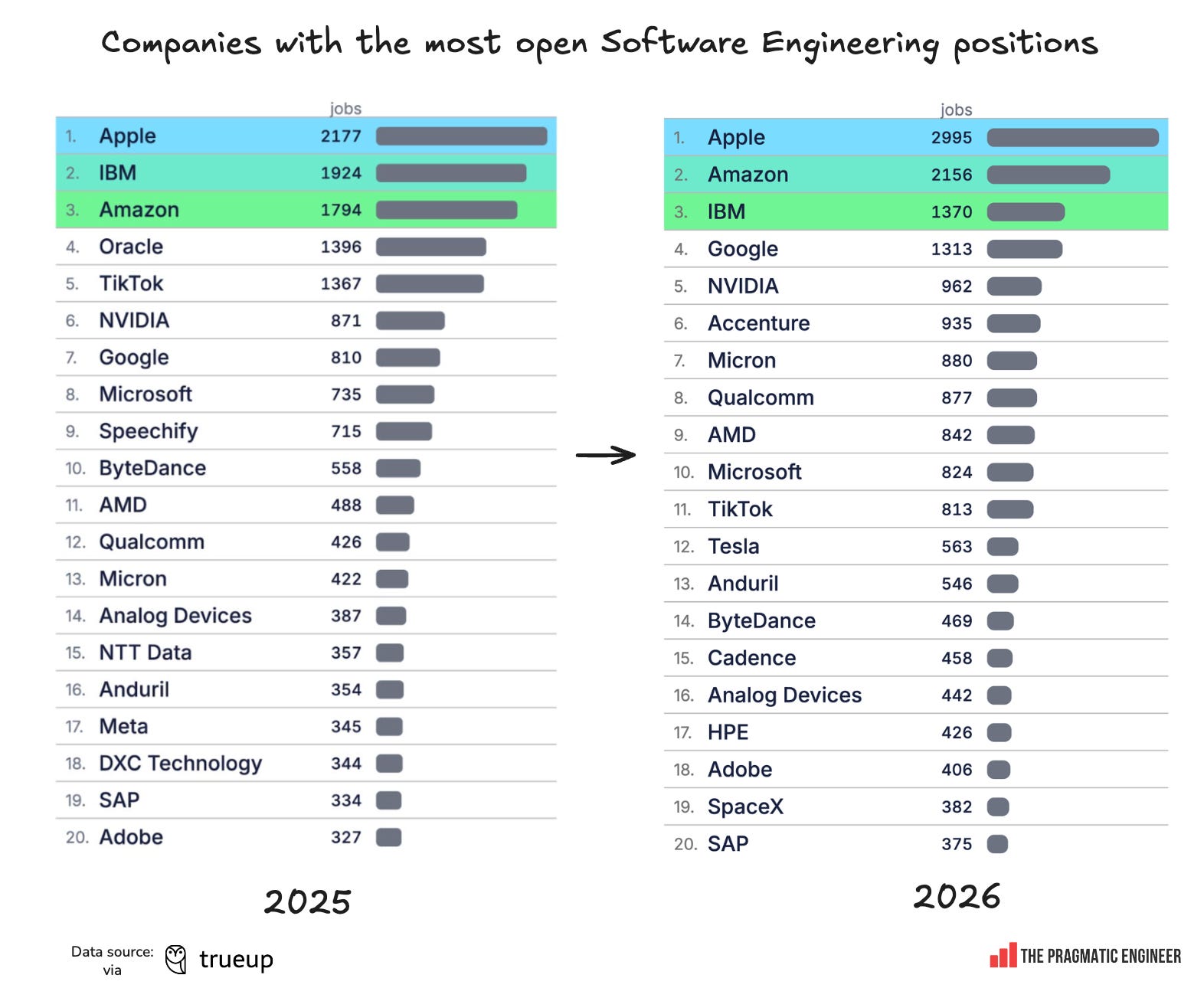
Observations:
The top three are unchanged: It’s still Apple, IBM, and Amazon
New entrants to the top 20: Accenture (consulting), Tesla, Cadence (hardware), Hewlett Packard Enterprise (HPE), and SpaceX.
Dropouts: Meta and Oracle. Last year, Oracle was #4 on the list with 1,396 open software engineering roles, but the company announced up to 30,000 layoffs in March. Also no longer leading in jobs available are Speechify, NTT Data, Meta, and DXC Technology.
Big Tech companies hiring more than last year: Apple and Google, which has +62% more engineering roles advertised than last year.
Big companies hiring less vs last year: Meta, Oracle, and TikTok all have much fewer openings listed. For Meta and Oracle, there’s little surprise given recent layoffs. TikTok was in US regulatory limbo until January, when a new TikTok USDS joint venture was established.
Hardware companies hiring more software talent: Micron, Qualcomm, and AMD all have considerably more software engineering openings than last year.
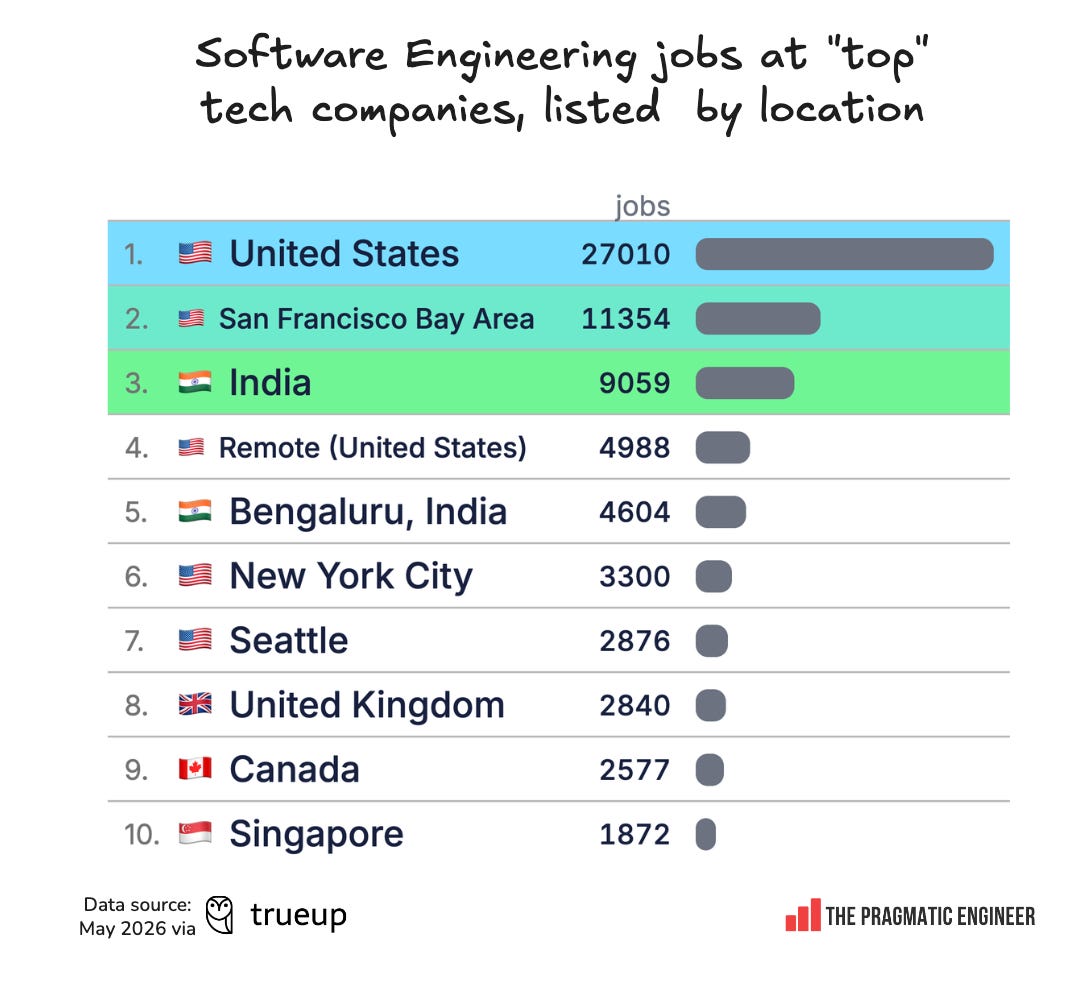
Where are the “top” software engineering jobs?
Most of these jobs are in the US, just as most companies leading in recruitment numbers are US-headquartered. Other leading locations for jobs are India, the UK, and Canada:
Fastest-growing: fintech and security
Then there are large companies where recruitment has been among the fastest anywhere in software engineering:
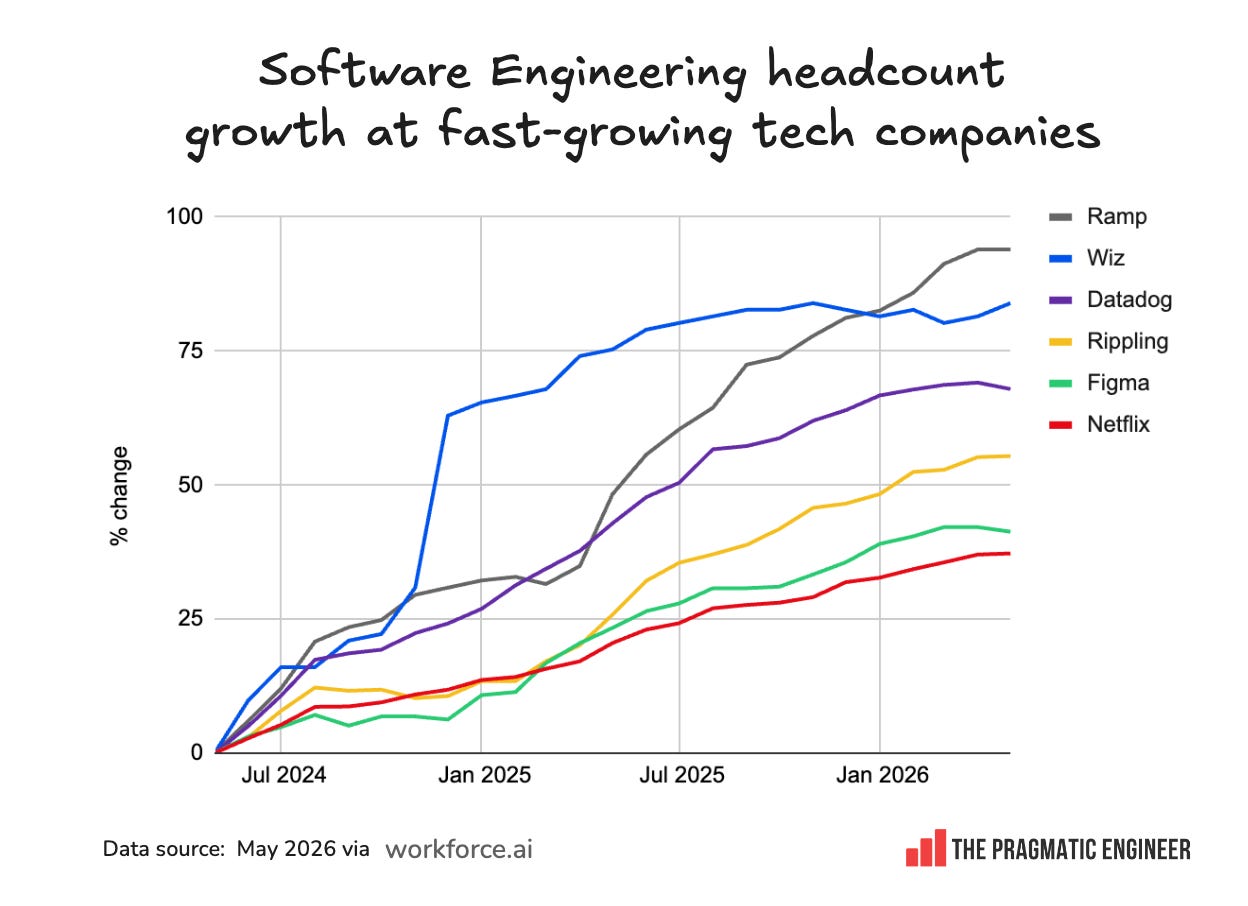
Software engineering headcount growth at some companies was significant over the past two years:
Ramp (fintech): +94%
Wiz (security): +84%
Datadog (observability): +68%
Rippling (fintech): +55%
Figma (design tooling): +41%
Netflix (streaming): +37%
Of this group, Datadog, Figma, and Netflix are publicly traded, and the largest by headcount:
Datadog: AI agents are driving demand for observability through the roof, and Datadog is the leader of the pack. There’s demand to expand their infra and offerings. AI companies are also customers: OpenAI famously – or infamously! – spent around $170M on Datadog in 2025.
Figma: the design tooling company went public in 2025 and is heavily investing in products related to AI, such as Figma AI.
Netflix: the streaming behemoth is transitioning from “just” being a video streamer to becoming a broader entertainment platform, doing live events, advertising, gaming, and more. We did a podcast with Netflix CTO, Elizabeth Stone, in 2025 about Netflix’s engineering culture.
4. AI engineering: explosive demand
AI engineering demand is only going in one direction: upwards, at a fierce tick. Last September, our previous State of the Tech Job Market report found that AI Engineering was the hottest segment in tech for job listings growth. Today, the trend seems to continue:
 | A guest post by
|