
The Pulse: Forward deployed engineering heats up again
Massive demand for the role at Google, OpenAI, and Anthropic. The latest version of the FDE role is starting to look similar to the consultant / solution architect role

Hi, this is Gergely with a bonus, free issue of the Pragmatic Engineer Newsletter. In every issue, I cover Big Tech and startups through the lens of senior engineers and engineering leaders. Today, we cover one out of five topics from last week’s The Pulse issue. Full subscribers received the article below seven days ago. If you’ve been forwarded this email, you can subscribe here.
Last August, we covered a sudden trend of high demand for forward deployed engineers (FDEs), and now there are signs demand is increasing more.
Google: FDE recruitment spike
Google is doubling down on FDEs and making the interview process much simpler. Google Cloud CEO, Thomas Kurian, has announced a new, AI-focused organization within the Go-To-Market team, and is hiring a bunch of FDEs for it.
I’m hearing the hiring process has been shortened from 4-6 interviews held over the course of weeks, to as few as two interviews in just two days. It looks like Google is unusually eager (desperate?) to fill this job.
OpenAI outsources FDE hiring spree
On Monday (11 May), OpenAI announced The OpenAI Deployment Company, a standalone entity funded by $4 billion of private equity from TPG, Advent, and others at a $14B valuation. It appears OpenAI is not an investor and holds a partner role.
The announcement mentions FDEs and says their job will be to “work closely with business leaders, operators, and frontline teams to identify where AI can make the biggest impact, redesign organizational infrastructure and critical workflows around it, and turn those gains into durable systems”.
Based on that, the FDEs will play an important role in OpenAI’s enterprise sales activity by ensuring the company’s AI systems work and deliver value for customers. Outsourcing this to the new Deployment Company should also free up OpenAI to focus on developing better AI models, while the partner company and its FDEs take care of the customer-facing side of things.
In a related development, OpenAI has acquired Tomoro, a UK-headquartered AI company founded in 2023, which employs 150 FDEs across the UK, Asia, and Australia. Tomoro is the first acquisition of the OpenAI Deployment Company.
Anthropic plans outsourced FDE recruitment
Anthropic is doing the same by creating its own distinct FDE consulting company. Last Monday (May 4), Anthropic issued an unusually hand-wavy announcement about the new business without a name and with few investment details mentioned.
Investors are Anthropic, Blackstone, Hellman & Friedman, and Goldman Sachs, and the new business will work with “mid-sized companies across sectors to bring Claude into their most important operations.”
Anthropic’s approach seems to be the same as OpenAI’s: create a standalone company with external funding, in which FDEs integrate Claude into enterprises that will then presumably start purchasing more Claude tokens than ever.
FDE or a consultant?
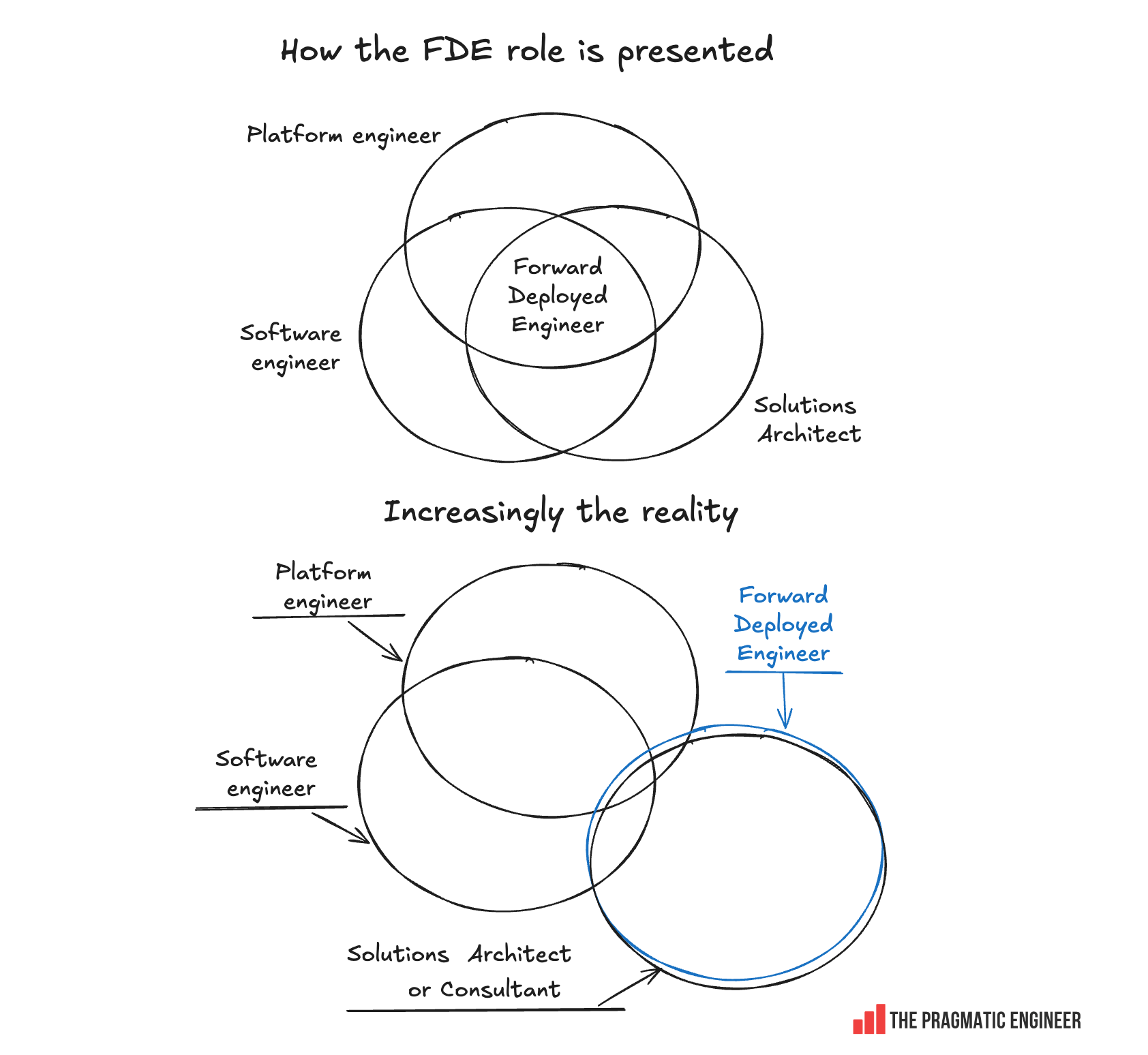
These FDE roles seem very similar to those of an external consultant or a systems integrator. A year ago, I talked with FDEs at OpenAI and Ramp whose jobs seemed a genuine mix of platform engineering – with an FDE contributing back to the platform – software engineering, in that they built new solutions, and also solutions engineering: integrating into customers’ services.
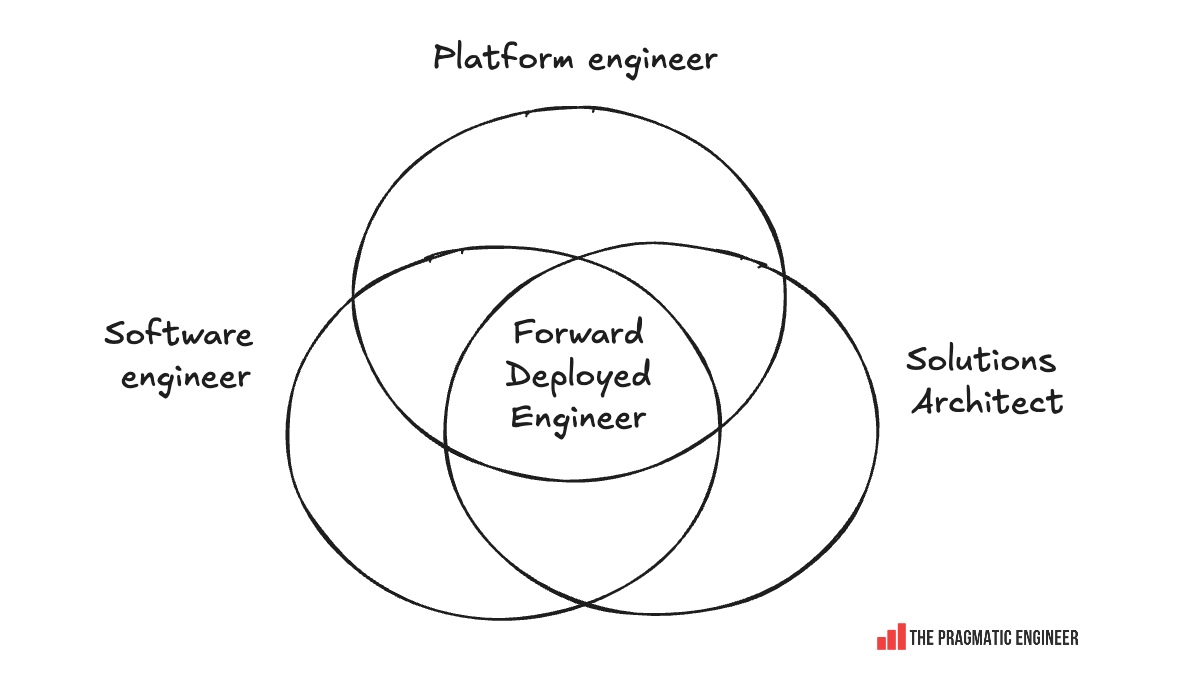
But today, it looks like the role is about to become indistinguishable from a solutions architect or consultant, especially given that these new FDE jobs are in quasi-external companies and separate organizations from where AI products are built.
Job adverts are increasingly clear about the role, but it still helps to read between the lines. Here’s one for an FDE at Google Cloud. At first glance, it’s impressive (emphasis mine):
“You are an embedded builder who bridges the gap between frontier AI products and production-grade reality within customers. Unlike traditional advisory roles, you function as an “innovator-builder,” moving beyond high-level architecture to code, debug, and jointly ship bespoke agentic solutions directly within the customer’s environment. Your role is designed for high-agency engineers with a founder’s mindset. You will address blockers to production, including solving the integration complexities, data readiness issues, and state-management challenges that prevent AI from reaching enterprise-grade maturity. By embedding with strategic accounts, you serve a dual purpose: providing “white glove” deployment of complex AI systems and acting as a critical feedback loop, transforming real-world field insights into Google Cloud’s future product roadmap.”
Translated into plain English:
You are a contractor who codes at a customer’s office. The actual job is around ~25% coding-related, 50% integration/plumbing, 25% meetings and customer hand-holding. Anything else will be assorted admin and internal process-related stuff.
Here’s what I reckon some of the terms in Google’s job advert will add up to on the job:
“Founder’s mindset”. No one will provide a spec, and scope creep is your problem to deal with. If your project doesn’t ship, that’s also your problem
“High-agency”. There are no resources besides your own
“White glove”. Do not say “no” to anything the customer suggests, even when they should probably listen to your feedback about whatever it is
“Critical feedback loop transforming real-world field insights into Google Cloud’s future product roadmap”. You will file tickets and a few PMs at Google may read some of them
But in all fairness, this FDE job looks like a great fit for some folks:
Those at the early-career stage who want Google on their resumes, but who might struggle to land a software engineering job with the tech giant
Those who enjoy shipping end-to-end, can work well with ambiguity (“founder’s mindset” is spot on!) and will own outcomes
On the other hand, I suspect this FDE role will not be a good fit for those who:
Like to build well-engineered systems and value the time to do it well
Like building greenfield systems
Prefer longer-term projects and working with other software engineers
In the cases of OpenAI and Anthropic, the outsourcing of FDEs is even clearer. Google at least hires FDEs to the company, and they will be issued some stock as part of their compensation package. But at OpenAI and Anthropic, new FDEs will be hired to a standalone company, and if they get stock, it will likely not be OpenAI or Anthropic stock. So, if OpenAI or Anthropic benefit greatly from FDEs’ work, then the FDEs won’t see the upside!
Putting it more simply: FDEs hired in these external companies will not be seen as “core”. If they were, then the companies would hire more FDEs, as in the past.
Opportunity for new grads?
As mentioned above, the new FDE roles could be a great opportunity for early-career software engineers entering the industry, according to Box CEO, Aaron Levie:
“If I were a college career counselor or in career services, I’d quickly be figuring out how to get students to understand these forward deployed engineer jobs exist and how to get them.
The requirements are a mix of deep technical skills, often CS majors or minors. You must be great at understanding problem solving, how to have systems thinking, and have a strong business acumen. The kicker, of course, is to make sure you’re very deep in AI agents; you need to have fluency in coding agents, MCP, CLIs, Skills, and so on.
Hundreds (thousands?) technology companies will be hiring for these roles, same with any consulting and IT services company, and the vast majority of mid-size and large enterprises will be hiring for this talent internally as well.”
Historically, tech consultancies hired many new grads for consultant roles, which are not so attractive to experienced engineers, but are great, real-world, paid learning opportunities for more junior ones. With product companies hiring fewer new grads, new grads will increasingly find FDE roles that they have a chance at getting.
All things considered, I expect demand for FDE roles to increase, industry-wide. They speed up AI rollouts, which several parties have an interest in doing:
AI labs: the faster that AI solutions roll out, the more revenue they make!
AI vendors: any company selling AI products will, similarly, want FDEs to help integrate the software with customers, so they can sell more
Non-AI companies: these will want to hire FDEs for an “AI transformation” and to integrate AI into workflows and products
Non-AI vendors: even SaaS companies that don’t sell AI products will be able to close larger clients if they hire FDEs who can roll out their software faster, and for more use cases, inside enterprises they work with.
FDE was the hottest tech role in 2025 and this trend seems set to continue this year. Demand for this role is high and rising, but it’s likely to stay unattractive to experienced devs for whom being a consultant may feel like a step down – especially after you’ve learned to love building products!
Read the full issue of last week’s The Pulse, or check out this week’s The Pulse. This week’s issue covers:
Antigravity 2.0 takes the ‘IDE’ out of its new IDE
Why is Google’s product ecosystem chaotic?
Meta cuts 8,000 jobs
Industry pulse
How to get a job at a frontier lab in 2026.
Read the full The Pulse.