
Stream the latest episode
Listen and watch now on YouTube, Spotify, and Apple. See the episode transcript at the top of this page, and timestamps for the episode at the bottom.
Brought to You by

• Statsig — The unified platform for flags, analytics, experiments, and more. Stop switching between different tools, and have them all in one place. Check out Statsig.
• Sonar – The makers of SonarQube, the industry standard for automated code review. Join me online at the Sonar Summit on March 3rd, where I and other eng leaders and devs will share practical strategies for the AI era.
• WorkOS – Everything you need to make your app enterprise-ready. One unique thing I learned about WorkOS: all software engineers are product engineers. Learn more about their unique working style in the blog Product Engineering at WorkOS.
In this episode
Every few decades, software engineering is declared “dead” or on the verge of being automated away. We’ve heard versions of this story before. But what if it’s just the start of a new “golden age” of a different type of software engineering, like it has been many times before?
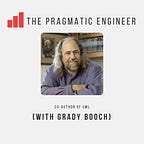
In this episode of The Pragmatic Engineer, I’m joined once again by Grady Booch, one of the most influential figures in the history of software engineering, to put today’s claims about AI and automation into historical context.
Grady is the co-creator of the Unified Modeling Language, author of several books and papers that have shaped modern software development, and Chief Scientist for Software Engineering at IBM, where he focuses on embodied cognition.
Grady shares his perspective on three golden ages of computing since the 1940s, and how each emerged in response to the constraints of its time. He explains how technical limits and human factors have always shaped the systems we build, and why periods of rapid change tend to produce both real progress and inflated expectations.
He also responds to current claims that software engineering will soon be fully automated, explaining why systems thinking, human judgment, and responsibility remain central to the work, even as tools continue to evolve.
Key observations from Grady on the state of the tech industry
Here are ten observations from Grady that I found the most interesting:
1. We are in the middle of the “third golden age of software engineering.” The first golden age was about algorithms (1940s to 1970s), the second one about object oriented abstractions (1970s to the 2000s) and this third golden age is about systems. This golden age started with the rise of abstraction from individual components to whole libraries, platforms, and packages — not with the recent AI boom. Though AI fits into this, as it helps create even more complex systems with less effort than before.
2. Existential crises are nothing new in software engineering. Grady recalls that when compilers and higher-level languages emerged, developers feared obsolescence then too — and the profession evolved.
3. We are an astonishingly young field — and that should ground our panic. “The term ‘digital’ was not coined until the late 40s, the term ‘software’ was not done until the 50s.” Some of the existential dread about AI is happening in an industry that’s barely 70 years old.
4. AI coding tools represent another rise in abstraction, not the end of engineering. Just as we moved from assembly to Fortran to object-oriented programming, AI assistants are “akin to what was happening with compilers in these days.” Grady frames it simply: “Fear not, developers. Your tools are changing, but your problems are not.”
5. Current AI tools are trained mostly on patterns we’ve already seen. Grady observes that tools like Cursor and Claude “have mostly been trained upon a set of problems that we have seen served over and over again.” They’re excellent at automating known patterns — especially web-centric CRUD systems — but the frontier of computing is far larger.
6. Deep foundations become more important as the field accelerates. Grady noted that the field is moving at an incomprehensible pace for people without deep foundations and a strong model of understanding. He specifically recommends reading Minsky’s Society of Mind for architectural guidance.
7. Infrastructure and delivery pipelines are ripe for automation — and job displacement. Grady identifies “the software delivery pipeline” as “low hanging fruit for the automation” — complex, messy work where agents can provide clear economic value. People in these roles will need to re-skill.
8. The shift now is from programs and apps to systems. Engineers who understand complexity at scale and can manage human as well as technical forces will see greater demand.
9. AI lets you redirect attention from friction to imagination. As Grady puts it: “Some of the friction, some of the constraints, some of the costs of development are actually disappearing for you, which means now I put my attention upon my imagination to build things that simply were not possible before.”
10. This is the time to soar, not to fear the abyss. Grady closes with a call to action: “You can either take a look and say, darn, I’m gonna fall into it, or you can say, no, I’m going to leap and I’m going to soar. This is the time to soar.”
The Pragmatic Engineer deepdives relevant for this episode
Timestamps
(00:00) Intro
(01:04) The first golden age of software engineering
(18:05) The software crisis
(32:07) The second golden age of software engineering
(41:27) Y2K and the Dotcom crash
(44:53) Early AI
(46:40) The third golden age of software engineering
(50:54) Why software engineers will very much be needed
(57:52) Grady responds to Dario Amodei
(1:06:00) New skills engineers will need to succeed
(1:09:10) Resources for studying complex systems
(1:13:39) How to thrive during periods of change
References
Where to find Grady Booch:
• X: https://x.com/grady_booch
• LinkedIn: https://www.linkedin.com/in/gradybooch
• Website: https://computingthehumanexperience.com
Mentions during the episode:
• Software architecture with Grady Booch: https://newsletter.pragmaticengineer.com/p/software-architecture-with-grady-booch
• Margaret Hamilton: https://en.wikipedia.org/wiki/Margaret_Hamilton_(software_engineer)
• Cosmic Calendar: https://en.wikipedia.org/wiki/Cosmic_Calendar
• Fortran: https://en.wikipedia.org/wiki/Fortran
• Edward Yourdon: https://en.wikipedia.org/wiki/Edward_Yourdon
• Tom DeMarco: https://en.wikipedia.org/wiki/Tom_DeMarco
• David Parnas: https://en.wikipedia.org/wiki/David_Parnas
• Whirlwind: https://en.wikipedia.org/wiki/Whirlwind_I
• The Mother of All Demos: https://en.wikipedia.org/wiki/The_Mother_of_All_Demos
• Edsger Wybe Dijkstra: https://en.wikipedia.org/wiki/Edsger_W._Dijkstra
• SAGE: https://en.wikipedia.org/wiki/Semi-Automatic_Ground_Environment
• Software crisis: https://en.wikipedia.org/wiki/Software_crisis
• The Ada Project: https://dl.acm.org/doi/10.1145/155360.155376
• JOVIAL: https://en.wikipedia.org/wiki/JOVIAL
• Abstract data types: https://en.wikipedia.org/wiki/Abstract_data_type
• Bjarne Stroustrup’s website: https://www.stroustrup.com/
• Simula: https://en.wikipedia.org/wiki/Simula
• Plato and the Nerd: https://mitpress.mit.edu/9780262536424/plato-and-the-nerd
• Oral History of John Backus:
• Functional programming: https://en.wikipedia.org/wiki/Functional_programming
• Blaise Pascal: https://en.wikipedia.org/wiki/Blaise_Pascal#
• What the Dormouse Said: How the Sixties Counterculture Shaped the Personal Computer Industry: https://www.amazon.com/What-Dormouse-Said-Counterculture-Personal/dp/0143036769
• Stewart Brand on X: https://x.com/stewartbrand
• Merry Pranksters: https://en.wikipedia.org/wiki/Merry_Pranksters
• The WELL: https://en.wikipedia.org/wiki/The_WELL
• Maintenance: Of Everything, Part One: https://press.stripe.com/maintenance-part-one
• Netscape: https://en.wikipedia.org/wiki/Netscape
• SOAP: https://en.wikipedia.org/wiki/SOAP
• ARPANET directory, 1974: https://archive.computerhistory.org/resources/access/text/2021/11/102805038-05-01-acc.pdf
• Herbert Simon: https://en.wikipedia.org/wiki/Herbert_A._Simon
• Marvin Minsky: https://en.wikipedia.org/wiki/Marvin_Minsky
• Allen Newell: https://en.wikipedia.org/wiki/Allen_Newell
• SNARC: https://en.wikipedia.org/wiki/Stochastic_Neural_Analog_Reinforcement_Calculator
• Edward Feigenbaum: https://en.wikipedia.org/wiki/Edward_Feigenbaum
• Lisp machine: https://en.wikipedia.org/wiki/Lisp_machine
• Thinking machines: https://en.wikipedia.org/wiki/Thinking_Machines_Corporation
• Hadoop: https://en.wikipedia.org/wiki/Apache_Hadoop
• Stuxnet: https://en.wikipedia.org/wiki/Stuxnet
• Grace Hopper Is The Computer Queen | Letterman:
• Anthropic CEO Says AI Could Replace Software Engineers in 6 to 12 Months: https://www.entrepreneur.com/business-news/ai-ceo-says-software-engineers-could-be-replaced-in-months/502087
• The Sciences of the Artificial: https://www.amazon.com/Sciences-Artificial-3rd-Herbert-Simon/dp/0262691914
• Sword of Damocles: https://en.wikipedia.org/wiki/Sword_of_Damocles
• The Society of Mind: https://www.amazon.com/Society-Mind-Marvin-Minsky/dp/0671657135
• A Robust Layered Control System for a Mobile Robot by Rodney Brooks: https://people.csail.mit.edu/brooks/papers/AIM-864.pdf
—
Production and marketing by Pen Name.