
The Pragmatic Engineer in 2025
The most-read articles of the year, plus some personal favorites, and a look back at a busy year in tech

This holiday season marks the end of the fourth year of The Pragmatic Engineer as my full-time focus, following more than a decade of working as a software engineer and engineering manager. Throughout 2025, you received 134 newsletters: a mix of in-depth deepdives, tech news in The Pulse, and conversations on software engineering in The Pragmatic Engineer Podcast.
As of today, the newsletter has 1,073,929 readers, of whom more than 200,000 have joined in the past year alone. Special thanks to paying subscribers, who get full access to all deepdives, issues of The Pulse, as well as extra resources for career growth, and content for engineering leaders. I’d like to thank everyone who reads this publication; your support is truly valued.
In this final article of 2025, I look back on the year and suggest some articles and pod episodes worth revisiting – or checking out for the first time.
Today, we cover:
Most popular articles. Five of the most-read, and five of my personal favorites
Podcast. Memorable episodes to check out
Tech industry in 2025. AI dominated the conversation and trends, the job market was weird, RTO accelerated, and much else
The Software Engineer’s Guidebook. Four more translations, a hardcover edition, and a best-seller in Japan!
See also annual reviews in 2024, 2023, 2022, and 2021.
1. Most popular articles
Over the course of the year, the articles below are the ones which were read by the most subscribers.
How Claude Code is built. Claude Code took the industry by storm in 2025, and we sat down with two of its founding engineers. They revealed how they helped make command line interfaces (CLIs) surprisingly relevant in such a short space of time.
State of the software engineering job market in 2025. It’s been a bizarre 12 months in the job market, when job seekers struggled to hear back about their applications, and employers found it hard to hire solid engineers. We delved into the state of things in a three-part series on data (part 1), what hiring managers saw (part 2), and job seekers’ personal stories (part 3).
Real-world engineering challenges: building Cursor. Founded in 2023, Cursor became one of the most – if not the most popular – dev tools this year. A deepdive into its tech stack, engineering decisions, and the database migrations which took place behind the scenes.
MCP Protocol: a new AI dev-tooling building block. The Model Context Protocol that extends AI capabilities for both IDEs and AI agents. An in-depth look at the technology with its co-creator, David Soria Parra.
AI fakers exposed in dev recruitment: postmortem. In March, a full-remote startup nearly hired a backend engineer who didn’t exist, after they used an AI filter and a fake resume to try and hoodwink recruiters. It’s also possible the scammer was a North Korean agent. Indeed, just a few days ago, Amazon caught one posing as a US contractor. Incidents like these have probably helped contribute to a decline in the number of remote jobs, and made it harder to get hired.
My personal favorites:
AI Engineering in the real world. What does AI engineering look like in practice? Hands-on examples and learnings from software engineers turned “AI engineers” at seven companies – with inspiration for how it’s relatively easy for a software engineer to become an “AI engineer.”
Inside Google’s Engineering Culture. A broad, deep dive into how Google works from the perspective of SWEs and eng managers.
What are Forward Deployed Engineers, and why are they so in demand? Startups and scaleups went on a hiring spree for a software engineering role pioneered by Palantir. A deepdive into the role, and why FDEs became so popular this year.
Cross-platform mobile development. Cross-platform mobile development was on the rise in 2025. An in-depth look into the most popular frameworks: React Native, Flutter, native-first, and web-based technologies, and how to pick the right approach
The 10x “overemployed” engineer. One improbable story this year was that of a clearly talented software engineer who tricked more than a dozen Silicon Valley startups. He aced the interviews and got hired – then proceeded to do almost zero work, all the while collecting paychecks and seeking out more job interviews. The music stopped for this blagger when one frustrated founder who’d hired and fired him went public.
See all deepdives of 2025 here.
2. The podcast
I launched The Pragmatic Engineer podcast 18 months ago because I was having interesting conversations with tech folks during research for the written articles, and it felt like a bit of a waste to not share these talks with readers in more detail. Overall, I’ve been very happy with the decision to experiment with the podcast format.
This has been the pod’s first full year, and the feedback has been positive. When I meet people at conferences and events, around a third say they discovered The Pragmatic Engineer via the podcast. At the end of this year, the podcast has crossed 10M downloads across YouTube, Spotify, Apple Podcasts, and other apps. In 2026, I’ll prioritize quality over quantity even more, so expect two or three episodes per month on Wednesdays.
Here are some highlights from the podcast in 2025, which are good places to start if you’re diving into the show for the first time:
How Linux is built with Greg Kroah-Hartman: the longtime Linux kernel maintainer breaks down the inner workings of Linux development; from its unique trust model, to the benefits of open-source contribution. This is the episode that was most popular with listeners this year, judging by the feedback.
Netflix’s Engineering Culture. A very rare peek into how engineering works at the streaming giant, with CTO Elizabeth Stone.
The Philosophy of Software Design – with John Ousterhout: why thoughtful software design matters more than ever, as AI transforms coding practices and developer workflows.
From Software Engineer to AI Engineer – with Janvi Kalra. Janvi impressed tech leaders after teaching herself AI engineering. She discusses the tactics and focus that helped her get into OpenAI.
How Swift and Mojo were created with Chris Lattner. A conversation about how better language and compiler design can open the door to faster, more accessible AI development, with one of the most productive software engineers around.
How AI will change software engineering – with Martin Fowler. Thoughtworks’s Chief Architect and author of the bestselling books Refactoring and Patterns of Enterprise Application Architecture, provides a level-headed take on what AI really means for the tech biz.
Measuring the impact of AI on software engineering – with Laura Tacho. Findings from 180+ companies on how AI really affects devs’ productivity – and what many teams get wrong.
Code Complete with Steve McConnell. Code Complete is one of the all-time most popular books on software engineering. Author Steve McConnell gives a rare interview and shares some career principles that every engineer should know.
Building Figma Slides with Noah Finer and Jonathan Kaufman. Behind the scenes on how a hackathon project turned into a polished product at Figma. Key engineering decisions, challenges, and practices.
Design-first software engineering: Craft – with Balint Orosz. You may not know I have a brother who also works in tech. Balint is the founder of the award-winning notes app, Craft Docs. An interview about what it’s like to be a design-first software engineer.
See all podcast episodes here.
If you have any recommendations for interesting guests for me to invite onto the podcast in 2026, you can let me know by replying to this email or via this form.
3. Tech industry in 2025
The main theme of 2025 has, of course, been AI, and how it’s changing software engineering – but we also covered numerous other matters and emerging trends.
The AI coding tools explosion. Claude Code rapidly became a favorite of devs, Cursor grew to be the most popular AI coding tool, the term “vibe coding” went mainstream (and was even pronounced ‘Word of the Year’ by Collins Dictionary – despite being two words), the MCP protocol won wide adoption, and coding with agents slowly overtook using AI for “just” autocomplete.
Weird job market stays tight. As we covered in the state of the software engineering job market in 2025 series, 2025 saw many professionals experience more struggle than usual to land the next job – except AI engineers and senior+ engineers with eye-catching resumes.
RTO acceleration. Amazon mandated a 5-day return to office in January 2025, and Instagram will do so from February 2026. Meanwhile, the share of full-remote jobs kept falling.
Decline of StackOverflow. This started before ChatGPT launched, but LLMs seem to have accelerated the decline. New generations of developers may have no idea what StackOverflow is, nor what made it so important in the 2010s.
AI-fueled cheating crisis. Remote algorithmic interviews provide little signal these days, now that invisible tools help candidates ace them without much preparation. In response, some companies allow AI tools in interviews and set more ambitious problems, while others restore in-person interviews. More on this in Ban or embrace AI in tech interviews? and How AI is changing tech interviews.
OpenAI’s aggressive expansion. The leading AI lab didn’t slow down in 2025, and is valued at a jaw-dropping $500B. It became a for-profit, launched a browser to compete with Chrome, bought experimentation platform Statsig for $1B, probably spent more than $170M this year on Datadog, and is making plans to go public.
AI surprises. Senior engineers use AI coding tools more efficiently than juniors, but equally, juniors are more “profitable” than before due to faster onboarding. AI seems to amplify coding knowledge for seniors, and could help juniors become seniors faster. Even though engineers at AI startups can usually use AI tools without any kind of budget limits – it is also AI startups which set extreme working hours cultures in their bid to outrun competition.
Weekly editions of The Pulse on Thursdays provided the latest news from around tech. Check out previous issues.
4. The Software Engineer’s Guidebook
It’s been two years since I published The Software Engineer’s Guidebook for navigating senior, tech lead, staff, and principal positions at established tech companies and startups. In November, I shared a recap to mark two years since publication, including learnings from taking the self-publishing route.
The book has now sold more than 40,000 copies, proving it was worth spending a very lengthy four years on writing it! This year, it was translated into four more languages, and is available in Japanese, Simplified and Traditional Chinese editions, Mongolian, German, and Korean.
In Mongolia, a 30-person startup did the translation, and this summer I flew over to visit them. It was there that I learned that the company which hosted me – Nasha Tech – also builds the Uber Eats of Mongolia.
A delightful moment was learning that the Japanese edition was a bestseller of the week at Tokyo’s largest bookstore:

As a fun fact, the Japanese edition is printed in a special way: it reads vertically (top to bottom), and right to left. The publisher – O’Reilly Japan – told me it’s an unusual but purposeful choice for a technical book:
“Generally, novels and typical non-fiction books use vertical writing, which requires right binding (right-to-left reading). Technical books, due to code snippets, are usually written horizontally with left binding.
However, for The Software Engineer’s Guidebook, we intentionally chose vertical writing with right-side binding so that readers can take their time with the content. It’s quite an unusual choice for an O’Reilly Japan book”.
In November, a hardcover edition was published, which I decided to do after a reader asked to have their paperback signed, and I saw it was in poor condition due to heavy usage, with lots of notes and highlights. Softcovers don’t withstand lots of heavy use, and seeing that beaten-up copy was the final prompt to create the hardcover.
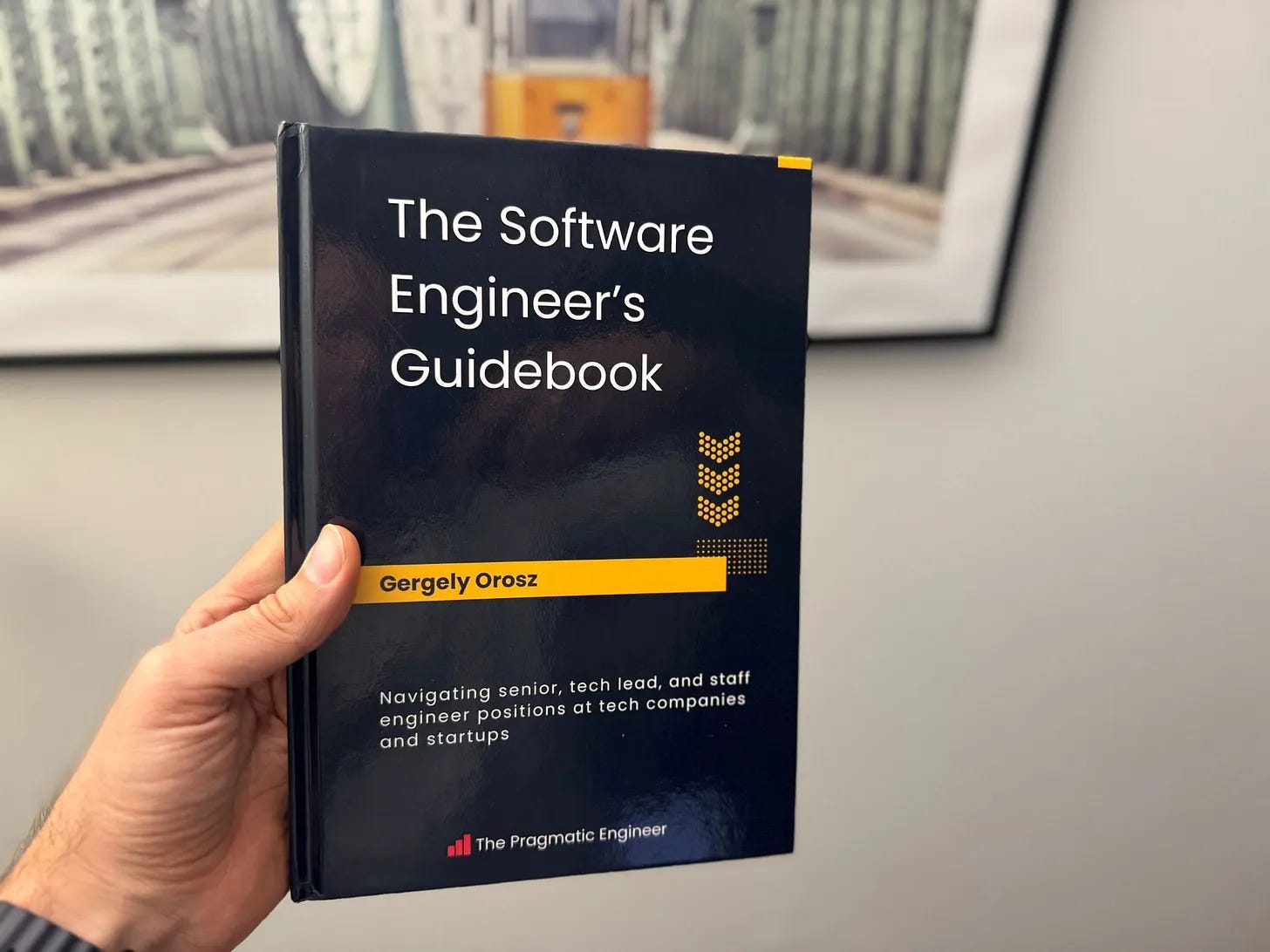
As a reader of this newsletter, you can get access to the bonus section of the book: 100 pages with ten online-only chapters. Get them here.
Happy Holidays!
With that, the newsletter and podcast head off for a winter break. I wish you and your loved ones a very happy holiday, with time to rest. If you end up being oncall during this period, fingers crossed for a completely uneventful one. If your company has code freezes in place for this period, this could help with that.
Thank you for reading this newsletter and listening to the podcast in 2025; there’s more to come in 2026.
Have a good one – see you in January!
Thanks for another year of high quality topics/articles that are industry relevant. Hope you have a nice break!
I've been a subscriber for years now, and intend to continue to be one for as long as you keep writing such insightful articles. I'm trying to read every post you publish. It's a significant time commitment, but I believe that it's paying off in giving me a great situational awareness in our industry at all times.